









Menu Close

Static Observatory

UAV-based Static Observatory

Screenshot 2025-08-25 141613

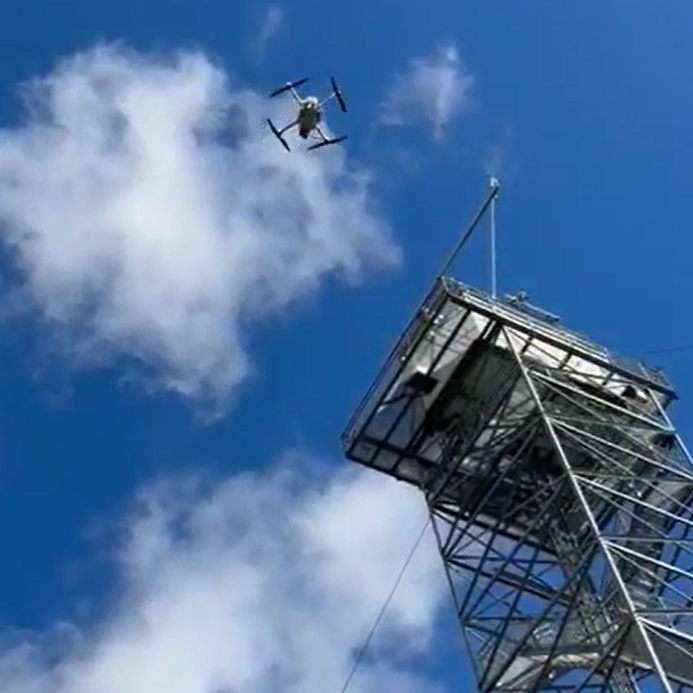
Autonomous UAV-based observatory for CH4 and CO₂ sensing.

MISO Autonomous UAV-based observatory based on the existing Skeyetech system. It is composed of a smart drone with sensors, a docking station with air-conditioning and a weather station. It can be controlled in real time remotely from a control room by an operator.

Key benefits:

GHG emissions can vary by more than a factor of ten over a few meters, and hot spot areas can be challenging to identify in the field. Measurements from static devices can cover only a small fraction of an ecosystem. MISO UAV-based observatory will allow vertical and horizontal measurements to make spatial upscaling of gas concentration and fluxes more robust and accurate.


Characteristics:

MISO UAV-based observatory has the following elements:  

  • The smart drone (based on model SKT-740 equipped with a high performance EO / IR sensor, size: 775x810x315mm, 7.5kg, with max flight time: 30mins. Maximum speed: 14m/s): a smart octocopter will have 8 engines (if one engine is down, the drone can still fly and land safely), a recovery system (embedded parachute),    triple redundancy of vital equipment; an ultra-performing geo-caging system for aerial safety. MISO’s smart drone will carry integrated MISO sensors, operating autonomously with flight time 30mins. 
  • The docking station (based on Skeyetech docking station, size: 200x170x100cm, 375kg, Equipped with an electrical and computer network box allowing data communication via 4G, IP cable or fiber connection): The MISO’s docking station ensures the protection and automatic recharging of the drone between 2 missions. It also ensures secure data transmission with the drone via LTE/4G or 5G. The station will be installed in areas with power grid access to supply electricity (230 Volt Mono, between 4 and 8kW power needed). To guarantee the appropriate internal temperature and keep the drone in standard conditions, an air-conditioning system can be added to the station.  
  • A weather station and a standard fixed camera (ST&SFC) (based on Skeyetech docking station) will allow MISO’s UAV-based observatory to get real-time information about the weather conditions (wind, rain) and real-time image of the station, in order to check before each flight the surroundings of the station.  
  • Smart software (based on Skeyetech software and interface) is the ideal solution for the isolated areas to monitor System status, to manage and select the flight mission (mission launch, mission pause, return to home, emergency landing, parachute triggering), to control the camera in autonomous ways, without needing direct human intervention.  AZD partner will create the flight paths/trajectories, into the controlling-navigation software, for every testing area in Arctic and Wetlands, following the researchers’ requests regarding the frequency of the flights and the altitude/s above the ground.  

Contact Info

Dr. Tuan-Vu Cao, project coordinator. 
The Climate and Environmental Research Institute NILU.

This project has received funding from the European Union’s Horizon Europe research and innovation programme under Grant Agreement No. 101086541.